 UNITED Static Control Products Contact us | Telephone 719 676 3928 | Search |
|
|
ElectraWear Cool ComfortShort Sleeve ESD SmockWe Challenge You to Find a Cooler ESD smock!
Just in time for those HOT production schedules! ElectraWear Cool Comfort short sleeve esd smocks are manufactured from a light weight yet extremely durable synthetic / carbon composite. Outstanding panel to panel and short sleeve to short sleeve conductivity of slightly more than 1 meg ohm! Cool comfort esd smocks are designed for use with short sleeve shirts eliminating tribocharging long sleeves at the source. Our conductive collar maintains good skin to smock conductivity.
And, unlike some heavy uncomfortable cotton blend esd smocks Cool Comfort won't shed fibers and handles repeated washings with ease. In fact Cool Comfort Smocks are Warranted to maintain conductivity at 100 washings minimum (50 more than the competition).
Cool Comfort ESD smocks are designed for employees wearing short sleeve shirts. The smocks only weigh a few ounces yet provide years worth of compliant problem free conductivity and low maintenance. Eliminating the long sleeves (and the tribocharging they can generate) lowers static propensity and provides one of the lowest tribocharging esd smocks in the industry! Available in snap front closure systems and in numerous colors.
AND like ALL of our ElectraWear ESD Smocks Our long term flawless electrical performance is unparalleled!
ElectraWear short sleeve smocks are designed for use by employees wearing short sleeve shirts and are not recommended for use as the primary method of grounding (as a replacement for ESD wrist or heel straps). For primary grounding smocks please visit our ElectraWear Ultimate.
ElectraWear garments are manufactured in strict compliance with requirements of ISO9001 and ISO14001 and made with nylon / conductive filaments subjected to rigorous testing for ESD protective performance, cleanliness/ particle shedding and durability. Utilizing HAD (Human Active Dynamics), advanced kinematics and physiology our esd garments are designed for fit and ergonomic comfort while providing the long lasting permanent ESD protective conductivity your ESD program demands.
ESD SHORT SLEEVE SMOCKS PRICE: $23.97 up to 2XL. Only $3.00 more for sizes 3X to 6X.
|
||||||

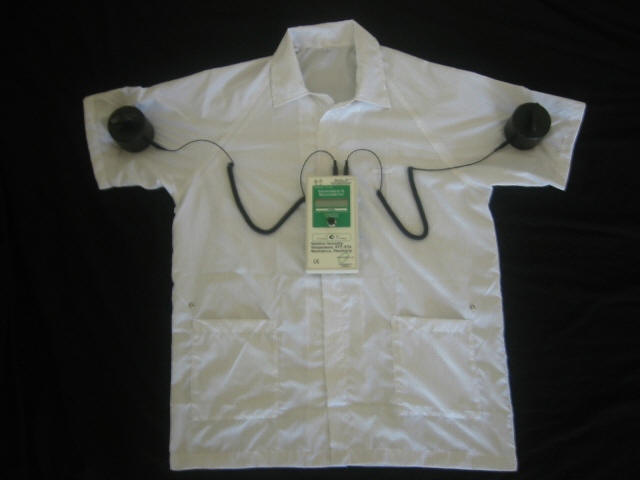 In our testing utilizing
the new TR53 sleeve to sleeve test methods (as required in
ANSI/ESD S20.20-2021) Cool Comfort came in at a reliable 4.24E06
at 38%rH, 67o F. and are fully compliant and
tested / inspected to the tough S2.1 protocol.
In our testing utilizing
the new TR53 sleeve to sleeve test methods (as required in
ANSI/ESD S20.20-2021) Cool Comfort came in at a reliable 4.24E06
at 38%rH, 67o F. and are fully compliant and
tested / inspected to the tough S2.1 protocol.
